THE RUBY JOURNAL · WEARING & CARE
Finding the Right Bangle and Kara Fit
A bangle or kara is chosen twice: once for its design, and once for how precisely it fits the hand and wrist it must travel over. The second choice is the one most often rushed.Prepared and reviewed by the Ruby Jewellers house team in Lahore · Updated 2 September 2026Measuring the hand, and the bangle itself
A closed bangle has to pass over the widest part of the hand before it reaches the wrist, so that width—usually taken across the knuckles with the thumb tucked in against the palm—is the true measurement to start from. If a bangle already fits comfortably, its inner diameter, measured straight across rather than around the outer edge, is an equally reliable reference for the next piece.
How sizes are written down
Inner diameter is often written as two numbers separated by a dash, such as 2-4, 2-6 or 2-8, using a traditional inches-and-fractions notation rather than a single metric figure. The exact increment can vary between workshops, so the size code is a useful shorthand—the actual inner diameter is what a fitting should confirm.
Round, oval, and the difference it makes
A perfectly round bangle is sized to the widest part of the hand at every point of its circumference. A gently oval profile can be easier to pass over the hand while still sitting closer to the narrower wrist once worn—a small change in shape that can matter as much as the size number itself.
Karas, openings and how they close
A kara may be solid, in which case it is sized like any closed bangle, or made with an opening—a hinge or a screw fastening—that allows it to be fitted without travelling over the hand at all. An opening changes both how the piece should be measured and how securely it needs to close before it is worn.
How many, and in what order
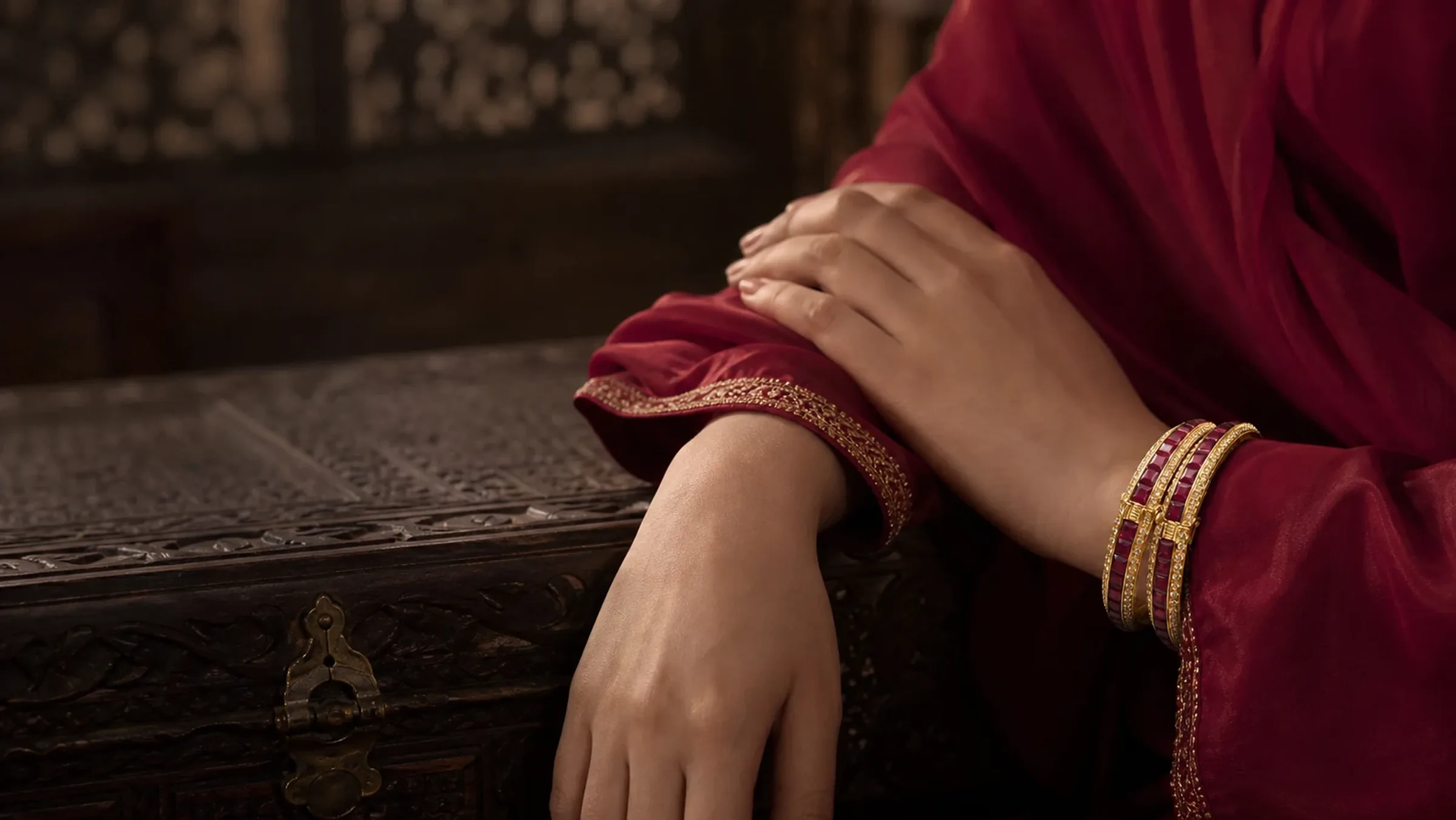
The right number is a matter of comfort and movement as much as look. Bangles meant to be worn together should be tried on as a set, since their combined width and weight behave differently than any single piece suggests. Where a kara is worn alongside bangles, comfort and how freely the arm moves are what should decide the arrangement, not a fixed rule about how many any wrist must carry.
When to stop and ask for an adjustment
A bangle that will not pass without real force, a kara whose fastening will not close securely, or a piece that marks the skin or turns constantly is a piece to bring back rather than persist with. Ruby welcomes pieces back to assess fit and make any adjustment the piece safely allows.
Questions, answered
How is bangle size usually measured?+
Across the widest part of the hand with the thumb tucked in, or from the inner diameter of a bangle that already fits well. Both give a jeweller a reliable starting figure for a proper fit.
What does a bangle size like 2-6 mean?+
It follows a traditional notation for inner diameter in inches and fractions of an inch. The exact increment can vary between workshops, so the size code is a useful starting point rather than a fixed universal standard.
Should a tight bangle or kara be forced on?+
No. A piece that will not pass, or a kara that will not fasten securely, should be brought back for assessment rather than forced. Forcing a fit risks the piece and, more importantly, the hand or wrist wearing it.